
The Worlds We Practice
And What We Carry Home from Summer Camp

My first summer music camp happened when I was four. At the end of it, I found myself Twinkling away beside Shinichi Suzuki himself, who was accompanying the grand finale at the piano.
For more than twenty summers after that, I had the privilege of intense study at music camps and festivals: Interlochen, Tanglewood, Aspen, Musicorda, Eastern Music Festival, and Isaac Stern’s Encounters in New York City and Jerusalem, among others.
Time moves on. For years now, I have been serving on the mentor side of that experience, and it is a privilege to live inside this cycle. As we wrap up the ninth annual Fry Street Chamber Music Festival, I find myself reflecting on what this tradition makes possible.
A successful summer music festival is the temporary creation of a whole world—a musical pop-up universe with its own intensified atmosphere, values, rhythms, and forms of belonging. For a time, everyone enters a field in which attention matters, effort is contagious, excellence is not merely displayed but shared, and young people are surrounded by adults who take both the music and them utterly seriously.
I remember faculty performances that changed my life as a student.
When I was fifteen, I spent a summer at Tanglewood. I had managed to sprain my finger playing volleyball, which put me in observation mode for a week. One day, I sat perhaps eight feet away as a young Yo-Yo Ma rehearsed the Shostakovich Cello Concerto with the Boston Symphony Orchestra.
I had never heard such passion and virtuosity. I remember feeling the windstorm of vibrations pulsing through and past my body.
Thrilling. Stunning. Unforgettable.
And then he spoke to me. Fifteen-year-old me!
He pointed out things to listen for in the score as the rehearsal unfolded and talked with me afterward about the piece. For the following year, I listened obsessively to his recording of the Shostakovich.
The performance itself expanded my sense of what was possible. But so did the fact that he noticed me—that, for a few moments, he invited me inside his own attention to the music.
This year at our festival, the faculty concerts carried some of that same energy. I saw it and felt it.
We welcomed astonishing guest artists1, including violinist Will Hagen, whose presence and playing undoubtedly raised the voltage.2 But what was really at work was the way excellence became ecological rather than individual. One person’s artistry quickened everyone else. A new synergy emerged. The staff made the conditions possible through tireless commitment, humor, and their belief in what we were doing. The students responded with their whole beings. The community sensed that something rare was happening and gathered around it.
The final concert was moving not simply because the students played well, but because everyone could sense what had happened to them—and between them—over the course of the festival.
This summer music tradition is tried and true, and the art form lives on through sustained mentorship. There is a kind of magic here. One that modernity has not fully captured or commodified.
A festival can be marketed. Tuition can be collected. Attendance, donors, participants, and outcomes can all be counted. But none of those measures can account for the moment a young musician realizes that an admired mentor truly sees them. Or the friendship formed between two teenagers who may remain connected for decades. Or the sudden expansion of what a student imagines might be possible in an artistic life. Or the deepened sophistication of one’s relationship with music itself.
Nor can they account for the way the rest of the world melts away because, for a time, everyone has agreed that listening this closely is the most important thing they could be doing.
Perhaps what resists commodification is that the deepest value is not contained in any one concert, lesson, or achievement. It’s what resides in relationship and transmission. Someone sees you, believes in you, and invites you into a larger musical world. It’s running into a friend from camp who, years later, is a colleague you make music with in the professional world.
The music itself lives this way, too: passed from the composer’s score into the interpreter’s hands, then offered to a room full of listeners.
I was invited into this cycle long ago. Now my colleagues and I have the privilege of tending one small expression of it—creating the conditions in which young musicians might be changed by the music, by one another, and by the experience of being fully seen.
My heart is full. I think our little festival has become one of those formative places. The kind that holds space inside one’s being for a lifetime.
Perhaps the festival’s magic is not really that the outside melts away. But rather that inside this temporary universe, everyone gets to experience another way the world might be organized: around attention, beauty, discipline, generosity, interdependence, and tending connection.
I remember the aftermath of my summer camp experiences all those years ago involving lots of letter writing (yes, with pen and paper!) to my new besties, and also the ache of the return to the “real world” which suddenly felt hollow. But even with the sense of loss that always followed, the richness of those experiences had a way of adding up and orienting me.
It seems to me that now, more than ever, in a world where attention is “harvested” as media colonizes more of our experience as the future feels increasingly uncertain, such experiences are more precious than ever. It reminds us that other ways of being together are possible. We can practice them. We can build the village for them. We can invite others in.
And then we carry some of that world forward.
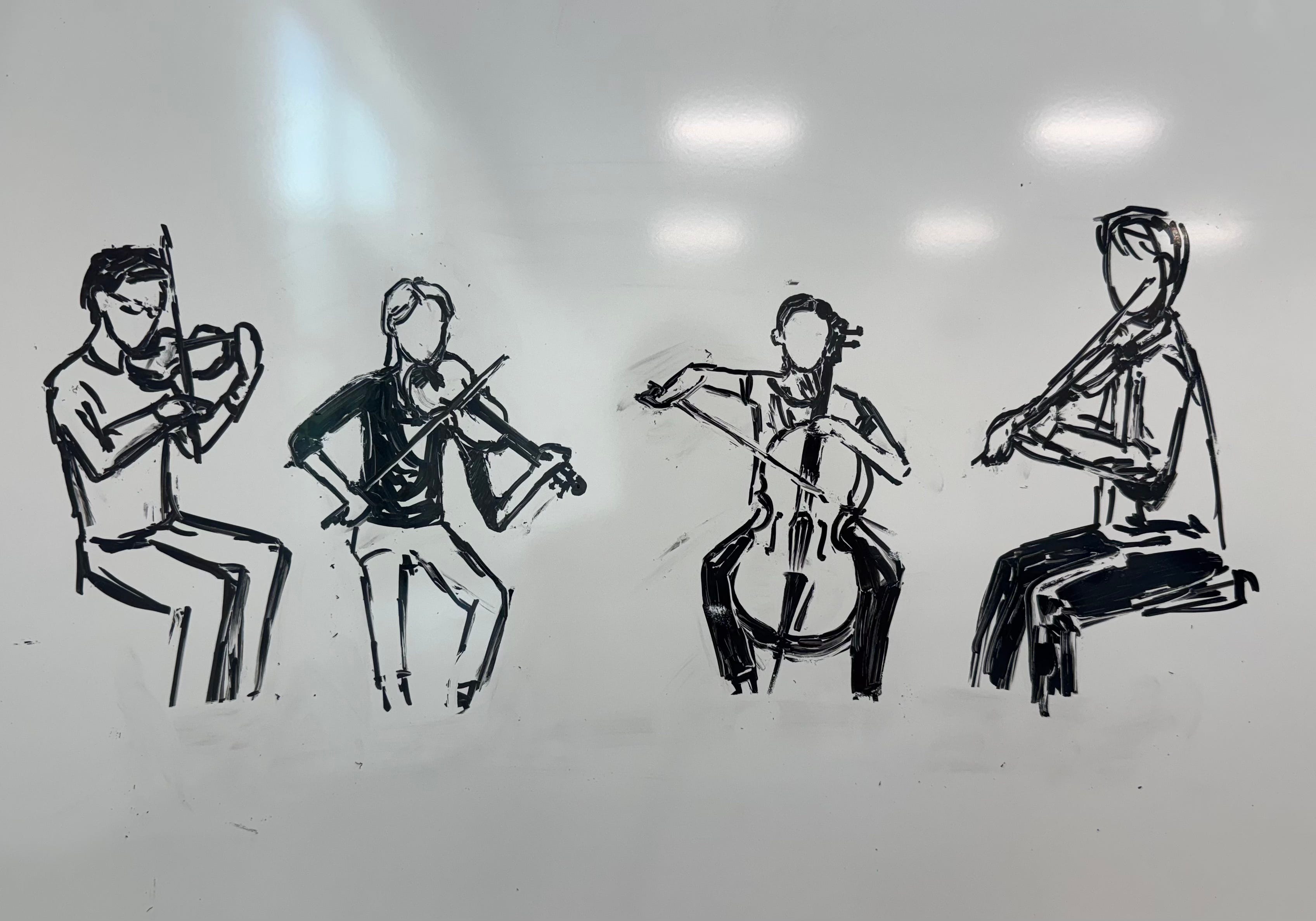
Heartfelt thanks to the following guest artists and faculty of FSCMF this year: Koji Attwood, Sasha Kasman Laude, Cahill Smith, Brant Bayless, J.T. Posadas, Jen Kozbial Posadas, Erika Hubbard, Maddie Marshall, Will Hagen, Matt Johnson, and Nell Flanders. Heartfelt thanks to our incredible staff: Executive Director Emily Ezola, Program Director Emily Taylor, and our Resident Assistants Carissa Devenport, Raif Milligan, and Lisa Wilson. And my undying gratitude to my incredible colleagues in the Fry Street Quartet, whom I get to make music with and dream alongside: Anne Francis Bayless, Bradley Ottesen, and Robert Waters.
This piece filled my heart to the brim as well! I absolutely adore picturing you in each stage of your young life having these amazing experiences. And now, here you are giving back with all your heart to each new generation of musicians!
I cannot love this enough! My heart is full of gratitude to you and Anne and previous FSQ members for what you established at VSI. I'm grateful as well for my own camp experiences. And, somewhat jealous of your Tanglewood experience. 😉